Sunday, 13 July 2014

MediEvil

Again, it has been a while since I last managed to post something here. I decided to post about one of the video games I find positively brilliant. I have never been a game addict, although I did have a period of about a year at the end of my PhD studies when I tried out various games from throughout the history of gaming. The game I'm writing here about is actually one I tried more or less at the time when it came out, and it has been one of my favourites ever since.


I should really talk about a series of games really. The first MediEvil is from 1998, developed exclusively to the PSX console. It is a combination of many things that makes it unique. The story in a nutshell is as follows. Sir Daniel Fortesque, the hero of the story is a skeleton night, who was resurrected by his old enemy, the evil sorcerer Zarok around 1300. Fortesque then has to go through various levels to find and kill Zarok. Now, so far it may sound nothing special, but it as always, the devil hides in the detail. It is the details of realisation that are unique. The story is a medieval fantasy mixed with a gentle Gothic horror style similar perhaps to that of Tim Burton. It is also humorous sometimes, and never excessively morbid or overly depressive like a Lovecraftian horror game might be. The genre to my mind is just ideal. Labeled action-adventure, it is a mixture of both and at the same time without some of the disadvantages of either. Many action games focus on body count without any real atmosphere, while many adventure games are centred on the story and atmosphere without anything particular to do other than visiting locations and talking to other characters. MediEvil has everything that I find attractive in a fantasy of this kind and at the same time it does have a "platformer" side with some nice puzzles and quite a few zombies to slash. The characters include a wide selection of foes and allies combined into MediEvil's own mythology. It also has a very nice music and graphics. The letter is especially evident compared to any other PSX games I know, some of which may be technically more advanced, but I venture that few others use their resources as well as MediEvil does.

The second instalment, MediEvil 2 was made in 2000. It takes us from the middle ages to 19th century London, where hell breaks loose after Lord Palethorn finds the spell book of Zarok and unleashes an army of zombies on the city. It is up to Fortesque to stop him. It is I think fitting to continue a story that started out in the middle ages in another era that had a romantic longing for that same period. Especially since it allows to bring in the Gothic fantasy monsters of the 19th century, like Dracula and or elements of the Frankenstein story, or on a different note, Jack the Ripper himself. It also allows some update in the weaponry, which may now include early modern gadgets. There are fewer levels in this game, but these are longer and harder on average. In short, this sequel adds a lot to the original, while it still remains within the same general framework.

The last game in the series, MediEvil: Resurrection is really a remake of the first one with some elements from the second. It is however, quite a different game, made primarily for PSP. It is worth exploring, although it did loose some of its fantasy charm due primarily to an effort to make it funnier, I think. 

Sunday, 2 February 2014

Lem and Communication: Fiasco

Stanislaw Lem was not only a well-known writer of science fiction, but he also published a wide range of critical writings on the genre. It is perhaps the latter side of his work that helped him identify accepted and often unrecognised assumptions popular within the genre, and develop themes in reaction to these.

One of his recurring themes is the problem of communication with alien life forms. This is the main theme of his arguably most well-known work, Solaris, and it was one of the reasons for the disagreement between Lem and Andrei Tarkovsky on the film version of Solaris. While Tarkovsky emphasised the "human angle" and the necessity to depart from the book while making a film, Lem intended to make an illustration of the sort of communicational problems mentioned above, which are related to that very human angle. It should perhaps be noted that as far as I can tell, the film version did not completely destroy Lem's intention, but the way Lem reacted to the acknowledged change of emphasis indicates very strongly the importance of the theme of communication in his work. Another one of his well known works, His Master's Voice takes this theme even further. In Solaris the problem can be summarised as: do two utterly different intelligent life forms - the human race, and a gigantic living ocean - have anything meaningful to tell each other at all? In HMV, the problem is even more academic: a regular sequence of signs coming from space is discovered, a message from the stars. Can we make  head or tail of it without knowing anything at all about the sender? HMV is related as the reminiscences of a scientist working on the decipherment project, in one long stream of ideas without any organisation of the text into parts, chapters at all. The shear number of possibilities of understanding and misunderstanding is devastating, and the project would culminate in complete confusion except for the fact that the project leads to new discoveries as a by-product.

Lem's Fiasco is yet another take on this problem of communication. This perhaps lesser known work of Lem would deserve more attention. For one thing, it is easier to read than HMV. True, it still has passages that depending on my mood  I either put down as the love of detail of a careful architect of imagined futures, or a pseudo-technological mambo-jumbo prolonging the prelude to content. To make this latter point clear one must admit that it is reassuring to know that whoever wrote this, took the pains to imagine a world in full detail, this commands respect. But it may not be necessary to reveal all this. If I compare the novel to a television broadcast of the theatre play, than a well done background is something everyone appreciates, but imagine what would happen if between the dialogues the commentator would go into detailed descriptions of that background. Interestingly, I found some of Lem's critical writings sometimes easier to read then e.g. HMV, for they were full of observations without interruptions of abundant detail. In Fiasco, the most critical part for me from this respect was the first chapter with its technological descriptions and Titanian landscapes.

Having said this, I think Fiasco is in many ways a more effective medium to convey Lem's warning about communicational problems than either Solaris or HMV. There is some sort of certainty of contact in Fiasco, where there is only a question mark in HMV. In Solaris the contact as far as possible creates a new psychological reality coupled with a number of other themes. Fiasco on the other hand is primarily a kind of caricature of contact attempts. These are treated as completely anthropocentric in scope, and the novel asks the question what if the others don't want contact? Fiasco puts the human race into the shoes of the UFOs of science fiction: humans visit a planet as a technologically superior race who have to find the means to communicate with the locals. The situation allegorically could be described as follows: a man travelling through a desert encounters two quarrelsome foreigners, and rejoicing in the possibility of company offers them friendly relations, but as he is ignored, and eventually even attacked he becomes more agitated and willing to show an upper hand. This is perhaps a good metaphor, except that we only imagine that what we meet in the novel can be interpreted in terms of human behaviour. Lem revolts against many popular themes here. In many sci fi novels, the relations with alien races are either peaceful or inimical but they always assume that there is a mutual understanding of concepts such as war and peace. In other words Lem says that humans don't look for alien civilisations, they look for humans in an alternative physical form. The object of criticism is the overwhelming optimism that contact is possible. I don't think Lem rules it out completely, but he finds the idea of the underlying assumption of blind optimism to be plainly stupid as there is plenty of room for less ideal scenarios. Fiasco is one such possible scenario, where at the same time this optimism eventually turns into an obsession and into the titular Fiasco.

There are several interesting characters in the novel. The ship's captain, Steergard, and a delegate, Arago, from the Vatican represent confronting opinions regarding their mission. Steergard aided by the ships omnipresent computer, DEUS, represents the colder calculating attitude, who is nevertheless in conflict with himself over his decisions. Arago, although a man of the church is not significant as a representative of an organisation but as a kind of consciousness amplifying some of the inner doubts of the captain in their conversations, but eventually it seems without little practical consequence. I would risk a guess that these conversations are perhaps semibiographical, as the atheist Lem is reported to have had long conversations with his friend Karol Wojtyla (later John Paul II) perhaps about similar matters. There is also a pilot, Tempe, recovered from a state of hibernation after an accident centuries ago. He is to some extent a twentieth century observer in the novel, although this angle is not very emphasised. Tempe is the person who finally lands on the alien planet, and in a way more personally related to the eventual fiasco. Finally, a Japanese physicist, Nakamura, whose zen philosophy sides him with Arago, while officially he takes stand by the captain. He also advices Tempe in a number of ways before the descent, most importantly he advises humility in the face of something completely unknown. The advice perhaps, taken more seriously, could have changed the ending of the novel.

Monday, 1 July 2013

Solaris

The dvd version of Andrei Tarkovsky's Solaris was the first dvd that I bought for myself, while still at the University. At that time, dvds were still new and rather expensive, while I was a rather poor student. The cost of the disk was the equivalent of several weeks food money, yet I decided that I will buy it. It is difficult to say why... I had read about Tarkovsky before, I was more or less aware of the story of Solaris as well. I remember I somehow found the presence of such a piece strange; I imagined I would have sooner found it on the shelves of some specialized store, rather than on those of a shopping center, surrounded by nothing of its kind. It somehow looked lonely, and I guess I saw a lost treasure in it. I went by it several times before I had the funds to finally buy it, but it waited for me patiently. I believe it is still to be found among my belongings I brought back from the University years, yet I haven't actually seen it for several years, until quite recently, the Solaris novel of Stanisław Lem came into my possession. After reading it, I decided to rewatch the Tarkovsky movie, and ended up watching the remaining two film versions based on the same novel. I thought I will commemorate the event by noting down a few things about these.


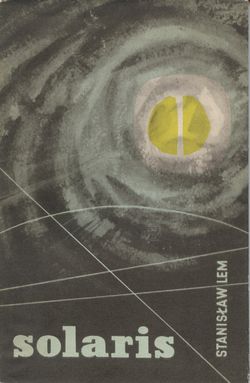
Let's start with the novel. Stanisław Lem (1921-2006) was probably the internationally best known Polish author of recent times. Among his numerous science fiction related and non-fictional writings, Solaris is the most well known, not entirely unrelated to the fame of the film versions, although Lem himself was rather critical of these. The main theme of the novel, which according to Lem has been largely overlooked by all adaptations, is the difficulty in establishing contact with an alien civilization. The underlying argument is that humans do not really look for new worlds, they look for the mirror images of their own, and once they encounter a form of intelligent life form that cannot be grasped in the framework of human notions, attempts to establish contact become difficult and are probably even bound to failure or are at least of limited interest for either parties. The sentient ocean of the planet Solaris is such a life form. It can only be partially compared to a brain or a cell, and by the different nature of its existence it likely has little to communicate to human beings. For a long time, the ocean largely ignores them, until strong irradiation triggers a response. Occupants of the space station located above Solaris, begin to receive visitors, animated forms of their own most hidden thoughts... Another nice feature of the novel, probably unsuitable for the medium of film is the description of Solaristics as a scientific trend, its ideas and its development. This is an intellectual effort that requires a lot of imagination; to come up with a sort of 'fictional science'. And for this very reason it is likely to be appreciated by only a few...


There are to my knowledge three film versions of Solaris. I tend to think about them as independent from the novel, and both Lem and Tarkovsky seem to agree with me, although for different reasons, and with different emotional coloring... The first version was a soviet tv adaptation, with a flavor of heroic comradery. The whole film is on youtube.


Tarkovsky and Lem collaborated up to a certain stage on the script of the movie, which ended due to artistic differences. The film keeps the plot structure of the novel, but alters its philosophy. Although the theme of contact is present in the movie, Tarkovsky used this as a starting point for a story more centered on human conflicts, the human reaction to the situation created by the confrontation with the sentient ocean. Unlike the novel, an initial large segment of the movie takes place on Earth, discovering the roots of the main character, Chris Kelvin, a psychologist sent to Solaris, to investigate what happened to the crew of the space station. The contrast to the novel is even more interesting, since Tarkovsky is considered a more 'epic' artist, in the sense that he takes time to create an atmosphere, in the sort of detailed manner comparable to novelistic descriptions, relying less on the dynamics of drama/action as the majority of films do. The difference in the views of Tarkovsky and Lem is more than formal, however. Tarkovsky's Solaris is after all, still a drama, a slow paced psychological one under alien circumstances, whereas Lem's novel is more in the nature of a philosophical pondering.


But the version that really maximalized the element of dramatic action within the Solaris story is Steven Soderbergh's adaptation. Of course, compared to the action packed space operas of today, this is probably still somewhat slow paced, but it is a bit hard to see in what way this adaptation would fulfill the promise of its makers that it would be closer to Lem's novel than the Tarkovsky version. The plot is close enough, but it focuses even more on the weird psychological scenario packed into significantly less runtime, and if the description of interpersonal relationships tend to overshadow the philosophical content of the novel, then this version is on the dark side. However, like some other things from the dark side it's not altogether that bad... It has sometimes been described with the formula 2001: A Space Odyssey + Titanic. Now from that recipe, anything can be concocted... On that note however, I would have been interested to see Stanley Kubrick's take on Solaris. Somehow I can imagine that his capability to keep emotional distance could perhaps paid off well for Lem's philosophical goals. Distancing is a much argued tool, but it is a tool after all, and perhaps not only Solaris, but sci-fi in a somewhat more general sense can benefit from it, since it is a genre where the underlying general idea may well rival the importance of the 'human element', as well demonstrated by the conflicting versions of Solaris.

Monday, 20 May 2013

Solar Rain

Sometimes I visit the NASA website just to see a few nice astronomical pictures, especially in the  Astronomy Picture of the Day archive. One can find nice things there, not only strictly about astronomy. Here, I picked a video about what would be the equivalent of rain on the Sun. The actual duration of the event is about 10 hours, so the website tells me, filmed in ultraviolet. Magnetically aligned plasma rain... that's something we don't have here on Earth. There is plenty of regular rain tho, enough to look out of my window...


Wednesday, 27 March 2013

Egg Shoeing

It's been a while since I saw an egg shoeing process, and recently I just remembered in connection with something requiring a lot of patience. Indeed, it was originally to demonstrate (and show off with) one's craftsmanship. There are still a few people who do egg shoeing ('tojáspatkolás') in Hungary. Next time I am impatient about something, I will remember to try and drive a nail into an egg instead...


Saturday, 19 January 2013

József Attila's Oh Heart! Be Still! Sung By Ágnes

Some years ago I did a translation of the song of Ágnes Vanilla below. It is part of an album, where each song is a musical adaptation of a József Attila poem. This particular one happens to be my favorite of the lot and it appears to be popular also among non-Hungarian people, and still one may find many requests for a translation on youtube. Mine got lost during the past few years, and there were many other attempts ever since. It is however, a very difficult task, since the lyrics is actually a poem of one of the greatest Hungarian poets, József Attila (Attila József in the English name order). The text is full of subtleties that are difficult to translate in the same compact verse form that the original used. I attempted that once. What I would like to do here is a bit different. I would like to give a transcription rather than a translation, in the sense that I would provide a more lengthy description for the lines than what would be possible if I attempted to put it into verse. The best suited person for such a task would be bilingual anyway, since only a person who knows subtleties in both languages can decide how to adapt or occasionally replace a phrase in the original with one that carries similar meaning in the target language.


József Attila had the difficult life of an artist, who found it hard to conform to some of the norms of his contemporaries. He attempted suicide several times, was fired from university, and got into conflict with the authorities because some of his poems were considered politically or otherwise incorrect. While previous generations learned that he was schizophrenic, updated textbooks urge the knowledge on younger generations that in fact he had borderline personality disorder. Whether his early death at the age of 32 in 1937 was an accident or suicide, is still not unanimously agreed upon. The fact remains he found his death among some railway tracks. His fame increased after his death, he is introduced to students among artists influenced by the Avant-garde (e.g. surrealism), others discuss his relation to transrealism.


The poem Óh szív! nyugodj! (Oh Heart! Be Still! written in 1928) repeated twice, is the lyrics of the above song. I will try to restrict myself to a technical/raw translation. The poem is a depiction of a winter scenery (daybreak), where various natural phenomena trigger poetic emotions. At least this is how I would summarize it, without too much explanation. Of course, here, and in the following, I base my translation on the image the poem triggers in my own mind. There are 4 stanzas:

Fegyverben réved fönn a téli ég,
Above, the winter sky daydreams in arms,

kemény a menny és vándor a vidék,
heaven is hard and the land is a wanderer,

halkul a hó, megáll az elmenő,
snowing decreases, someone leaving stops,

lehellete a lobbant keszkenő.
his breath is the flickered handkerchief.

The verb 'réved' is related to the French 'rêve' (dream), and perhaps could be translated as 'be in a reverie'. I personally imagine here that certain sleepy awareness that just precedes full awakening, and so it could perhaps also be translated as 'awakes armed in a reverie', though that sounds a bit complicated to me. The land is a wanderer could perhaps also be rendered as 'the land wanders'. In 'halkul a hó' halkul lit. means to become less loud, all in all it would be "the snow becomes less loud". In the last line flicker stands for 'lobban', which refers to one flicker rather than many rapidly suceeding ones (the latter would be 'lobog').

Hol is vagyok? Egy szalmaszál nagyon
Where am I? A straw moves about

helyezkedik a csontozott uton;
intensely on the boned road;

kis, száraz nemzet; izgágán szuszog,
little dry creature; snuffs restlessly,

zuzódik, zizzen, izzad és buzog.
(it) gets bruised, buzzes, sweats and boils.

The first two lines constitute one sentence (other than the initial question). 'Helyezkedik' means something like tries to find its place. For 'csontozott', 'boned' is risky. The first meaning of the corresponding verb would be to remove the bones, and so the participle here would mean boned or boneless. Together with the winter context I imagine bony patches of snow on the road when I say 'boned road'. The word 'nemzet' means nation, and I have seen it translated like that many times. However, I think 'nemzet' here stands in its more direct derivative meaning (something similar to 'fajzat'), i.e. 'creature'. The last line has a phonetic message, all verbs there contain 'zz' reminding one to noises a piece of straw could make.

De fönn a hegyen ágyat bont a köd,
But up on the mountain, the mist is making the bed,

mint egykor melléd: mellé leülök.
like once beside you: I sit beside it.

Bajos szél jaját csendben hallgatom,
I listen in silence to the laments of the troubled wind

csak hulló hajam repes vállamon.
only my falling hair flies about on my shoulder.

'The laments of the troubled wind' would lit. be the 'ouches of...' where 'jaj' is 'ouch'.

Óh szív! nyugodj! Vad boróka hegyén
Oh Heart! Be Still! On the mountain of the wild juniper

szerelem szólal, incseleg felém,
love talks, flirts to me,

pirkadó madár, karcsu, koronás,
a dawning bird, slender, with a crown,

de áttetsző, mint minden látomás.
but transparent as all visions.

And here, one has actually little trouble to give a literal translation. The question remains whether all this helps to understand the original? To convey the poetry, definitely, a poetic translation is needed, more suited to the subtleties of the English language. But in such a procedure, the taste of the original is likely to suffer, and I hope that with this more literal translation, I have managed to transfer at least some of it.

Thursday, 29 November 2012

Les Diaboliques

"Les Diaboliques" is the title of the film adaptation of the Boileau-Narcejac novel "Celle qui n'était plus" (She, who was no more). Written in 1952, the novel appeared in English in 1954, and in 1955 it was made into a film by H. G. Clouzot, who obtained film rights to the novel a little before Hitchcock could have. All the more interesting, that today the name Boileau-Narcejac seems to have lost its familiar ring to the fans of the thriller genre, unlike their American counterparts (e.g. Chandler). English translations of the novel are hard to come by and some sellers ask astronomical prices for them. The pseudonym refers to two authors, Pierre Boileau and Thomas Narcejac, who much in the style of Ellery Queen, divided the task of plotting and writing among themselves. The aforementioned novel is their first success to be followed by many other.


The first thing that comes to mind about the rather short novel is the strong atmosphere. The reader follows a murder plot, and as the characters move along in the dark and misty world surrounding them, one has the feeling that we are turning away from reality into a world of inner fears to complete a psychological journey with a dramatic conclusion at the end. It is like a landscape at night, with an interplay of dark shades that has some unearthly beauty for the outside observer, but crushes the main character with its deadly magnetism. The novel consists of such scenes, for instance a nocturnal journey with a dead body in the back of the car, where every little obstacle tries the mental stability of the plotters. Much emphasis was laid on the ending in the trailer for the movie. It should be mentioned that whereas the background had been changed for the movie, the structure of the plot, and the main twist survived. However, the film is much less pessimistic, the atmosphere is somewhat lighter. Nevertheless, it was made in the spirit of the novel, about the same aspects of human nature. Interestingly, there is an exchange of roles as the main character in the novel corresponds more to his wife in the movie, and vice versa. It seems the makers of the film did not envision a psychologically tormented, weaker male character, but a rather menacing and tyrannical one. Thus, in a way, film and novel are complementary, both recommended heartily.

Sunday, 7 October 2012

Judge Dee

At one point, while writing parts of a history of detective stories, looking for possible oriental relatives, I stumbled upon the name of Judge Di (Dee). Di Renjie (630-700) is a historical figure, a capable minister of the Tang dynasty. Loosely based on Di and his reputation, an unknown 18th century author wrote "Di Gong An", a detective novel in which Di as a magistrate investigates a number of crimes. A copy of this was obtained by the dutch sinologist Robert Van Gulik in a Tokyo second-hand bookstore, and was later translated by him into English as "Celebrated Cases of Judge Dee". More precisely, he translated the first part of the novel, and argued that the second part is a later addition much inferior in style and plot. Van Gulik wrote a detailed introduction to his translation, in which he observed some differences between the oriental and western styles of detective stories. He intended to introduce to the Western audience an authentically Chinese detective, unlike the stereotypical Western inventions popular at his time. Then, he went on encouraging authors to write similar stories based on these rules. Eventually, he did so himself, and invented a completely imaginary career for Judge Di spanning over several locations and levels of Chinese jurisdiction. One of the most notable characteristics of the Judge Di novels is the parallel investigation of several cases in the same time, which are investigated by the magistrate with the help of his trusted lieutenants. Although the whodunit is not typical in Chinese crime fiction, Van Gulik often centered the mystery around the identity of the murderer in his novels, which he illustrated himself. After his death, many authors continued his work, most extensively F. Lenormand in French.


There have also been film adaptations of the character. A close adaptation of the Van Gulik novel "Judge Dee and the Haunted Monastery" was made in 1974. The Chinese television also started a series about the historical character, Di Renjie, and in 2010, Tsui Hark did "Judge Dee and the Mystery of the Phantom Flame" featuring Andy Lau in the titular role. Both Chinese adaptations take place in the period of the reign of Wu Zetian. Wu is certainly one of the most intriguing figures of Chinese history, and the only woman to have obtained the title of huangdi as founder of the short lived Zhou dynasty (690-705). It is certainly an attractive proposition to bring together two such historical figures in one plot, though Di should have been around 60 when the events of the Phantom Flame were supposed to take place. Both Chinese film adaptations are wire fu, and there is a new Tsui Hark film coming out as a prequel. On the other hand, Haunted mystery is a sort of cheap but faithful adaptation. Faithful, I mean, to the book by Van Gulik. By the time he wrote Haunted Monastery, Van Gulik seems to put less emphasis on the court procedure and other details, e. g., the morbid details of execution in the end, and the setting of an old monastery with a spooky air where he takes shelter when his journey is interrupted by a storm gives just the right background to dispose of these formalities. Van Gulik still keeps that original feature of his novels to set his plot in the Tang dynasty but describe customs of the Ming, as did the anonymous writer of the original Di Gong An. However, the average viewer of the film version would notice few of this, and I don't think it makes a big difference given the rather improvised settings, nowhere near the sometimes purely imaginary magnificence of the past as in Phantom Flame. The environment also provides Van Gulik with the possibility to discuss the differences of thought advocated by Confucians and Taoists, but again, the film carries over little of this. However, the plot is almost unchanged, which is a huge advantage, as Van Gulik used elements of recorded case histories in his novels, and thereby one has the chance to get some insight into the Chinese way of thinking about, committing and investigating crime. While writing to a western audience, Van Gulik repressed the role of the supernatural, which occasionally occurs in Di Gong An. Phantom Flame restores this element to some extent, in the manner of a Chinese phantasy, though once one accepts these elements as belonging to a mythical past, the flow of events - even if somewhat on the fantastic side - can still be reconstructed by logical deduction, which is why this may be called a detective story after all. At this point, I would compare the Phantom Flame to the French movie 'Vidocq', which builds similarly on the myth (or reality) of alchemy.

Sunday, 29 July 2012

Magic and Poetry. Miyazaki's Howl and Others

Reason is important and should play a large role in our lives. After all, we enjoy achievements of technical and other kinds that are largely thanks to reason. Many of the forms of magic is also reasonable, if not entirely scientific. However, the aspect of magic closest to me is its relation to the irrational and the imaginary. The latter two are important, even if we assume that everything can be explained on a purely rational basis. In fact, one of the major underlying theme of current social problems , I think, is the inability to deal with the irrational. On the one hand this means that there is an irrational aspect of the human existence (and again, it may as well be described by rational means), an important one, which does not want to follow rules and laws. Instincts, hidden desires and the sort, some of which are simply banned, ignored, maybe punished, until they possibly return in a monstrous form (to borrow an expression used to describe Gothic horror). On the other hand, there is a not entirely unrelated, but rather more purely aesthetic or atmospheric aspect, that I merely refer to as poetry. This latter aspect is the one that I wanted to deal with here, solely in the framework of fiction.


It is the appeal of magic, which is magical. Whether it is an an atmosphere of ancient wisdom and sorcery or enchantment by the beauty of something, it is the appeal that I like and not whether it works in the physical world or not. In this sense it can be a very useful, in a way surreal craft to approach real and unreal in fiction. There are plenty of examples. Lovecraft's myth and its deadly book the Necronomicon, that so effectively embodies the occult and fearful, since we never can read it but know that whoever did, went crazy or worse. There is Polanski's "Ninth Gate" which takes us to the realm of old books, very rare and containing hidden knowledge only to the initiated. There is Burton's "Sleepy Hallow", an adventure in the world of Gothic and magic.


However, I wanted to show a few clips from Miyazaki's "Howl's Moving Castle" as ones I especially like. It is the story of a magician, Howl, who gave his heart to a demon, and a young girl, Sophie, who is turned into an old woman by a witch. The country is in war, which Howl finds mad, and sometimes interferes with. He is also hiding from his teacher, the royal sorceress, Saliman, who wants to put a control on magical practices in the country. The first scene shows the discovery of a malicious magic spell. I merely post it because it has the appeal I was referring to. The second is the confrontation scene with Saliman, where Sophie, now as an old woman, poses as Howl's mother. I love the idea of danger hidden behind such innocent looking things as that chanting... Like in other works of Miyazaki, there are lots of surreal images, events and characters, which somehow look familiar but yet which would be hard to explain. In a way they are also about reality as experienced by the viewer, and yet things just "melt together" as if in a dream. Howl is especially a good example of this sort of magic...

Magic, Rituals, Demons. Ritualistic Magic

I remember a psychiatrist once telling me he didn't believe in god, but always he always prayed before driving. His explanation was that it helps him relax, remove anxieties of what might happen and so on. Indeed, much of the history of "common magic" is about attempting to remove such real or imaginary threats from one's life. Rituals, ceremonies, prayers could be a useful tool to achieve this end. Indeed, often the ritual is more important that the actual credence in the reality of the thus addressed deity. Still with any tool, I guess the secret is how to use it, and what it should not become is an automatic procedure of habit or tradition.


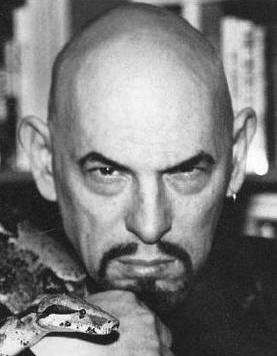
Magic always had a ritual aspect. Contemporary magical trends owe a lot to the work of Eliphas Levi, who developed a system of rituals and their theory, based in a large part on Renaissance traditions. The person who pushed ritualistic magic to its limits in the early 20th century was Aleister Crowley (see above). Being "the most evil man in the world", his hedonistic rituals including sexual practices and the use of drugs made him a scandalous figure of his time. He placed the notion of thelema, or true will (true in the sense that it also incorporates one's higher destiny) in the center of his practices, and experimented with I would say whatever the human body and mind could take, eventually ruining his health. As some of his practices would lead to less attention nowadays, I would also venture saying that some of the sort of hedonistic experiments he pursued are now incorporated into what is regarded as normal or acceptable, and such experiments may have played a crucial role in this change. Another development in this regard was the Satanistic movement of Anton LaVey (see below). LaVeyan Satanism is symbolic, i.e., it does not include worship of a Satanic deity, but rather uses Satan as a symbol of man's true nature. For example, the Satanistic parallel to the Christian Golden Rule would be "Do unto others as they do unto you", simply because it is considered false to expect the same consideration from others as one pays to them, since it is not in human nature. Here I would halt for a moment. While I sympathize with this dictum since it very often proves true in my personal experience, I think the same potential source of mistake is there as with the Christian parallel, namely mindless application justified by a doctrine. In other words, I think it is really the individuum that matters, and could make an intelligent decision whether in a given situation one or the other action would be appropriate. It involves risk as any action of free will. In any case, the modern satanist seems to pay much attention to individualism and materialism. Magic is now a psychological means to govern situations or focus one's emotions to a given purpose via rituals. On a final note regarding rituals of any kind, I think their danger lies in biasing ones own view on the world one way or the other, and so they may become the master rather than the servant.


While I do not fancy any form of religion or thought connected to churches or other organizations, since after all this is a private matter, one has to appreciate the role these organizations play in the course of history, and evaluate the appearance of newer ones as indicators of important questions of the time. Neopagan movements including modern Witchcraft, or Wicca, should also be mentioned among the practitioners of modern ritual magic. Their ritual practices appear much more light-hearted and playful than those mentioned above, they are perhaps advocates of an imagination less bound by reason.

Magic In The Renaissance. Natural and Spiritual Magic

In the history of magic, the Renaissance age plays an especially important role. While learned forms of magic were also to be found in the Middle Ages, it was because of the Renessaince rediscovery of ancient texts and cultural heritage that magicians felt they possessed a much fuller understanding of ancient traditions than their medieval predecessors. Magic became one aspect of a philosophical rediscovery of Platonic ideas as opposed to the Aristotelian scholasticism of the Middle Ages. Greek texts from the Byzantine empire, and arabic magical texts written under hellenistic influence became the primary sources for the Renaissance Mage.

Above all, the main influence was Marsilio Ficino's translation of the Corpus Hermeticum, writings attributed to Hermes Trismegistos, the supposed Egyptian equivalent of Moses. Although later scholarship discovered that this and other writings attributed to Hermes can be dated to the second or third centuries only, indicating a strong Neoplatonist influence, Renessaince scholars believed these texts to be much more ancient, and in fact to be the original influence on Platon. The authority thus attributed to them made Hermeticism and attached magical practices appear in a much more favourable light than did Medieval necromancers, and other learned practitioners of magic. Ficino then developed a sort of "natural magic", which aimed at exploiting the physically available forces in the Neoplatonist universe, namely those from planetary influences, which could be used to one's benefit through the arrangement of one's environment in a way sympathetic to a planetary force and the corresponding mental and other advantages. Furthermore, talismans could be prepared which would enhance the accumulation of such influences. Although the latter aspect was much frowned upon, Ficino avoided any attempts to manipulate spheres above the planetary one, inhabited by angels and other spirits, and he thus managed to avoid most accusations of heresy and the like. Later, this was to change when Pico della Mirandola introduced the Jewish Cabalistic tradition into Renessaince magic to attract angelic influences, and by the influential work of Cornelius Agrippa, who did not even exclude demonistic influence (see planetry symbols from his work below). The most notorious case was that of Giordano Bruno burned at the stake for his Hermetic beliefs now without Christian disguise. It was also on account of the importance Hermeticism placed on the sun that Bruno incorporated the Heliocentric view of Copernicus into his system.


At this point, magic and science are pretty close to each other, especially in the sense that both aimed at operations, producing effects in the world based on an application of knowledge, which was foreign from the contemporary scholastic thought. Hermetic influence decreased in the following centuries, especially since its sources were dated in the mean time, and as an operative explanation of the universe, the mechanistic universe was brought forward. Still, even Newton's mechanistic universe with gravity as an operational force reminded many of the invisible forces of the occult. Indeed, the better understanding of the nature of gravity came only through the work of Einstein, and continues arising questions until the present day.

Saturday, 28 July 2012

Walking My Baby Back Home


"Walking My Baby Back Home" is the title of a popular song that gave its name to a musical made in 1953. Above is the title sequence of the movie, and the first musical piece, the equally popular "Glow Little Glow Worm". The story is about a musical band looking for an identity, and finally finding it by rediscovering to Dixieland Jazz. Probably not the most famous one of musicals, and not with an overly complicated plot, but what is important, with a number of good musical tracks. In the main roles are Donald O'Connor, probably most well known for his role in "Singin' in the Rain", and Janet Leigh, most remembered after her meeting a terrible end under the shower in Hitchcock's "Psycho". On a personal note, I think O'Connor should have been given more opportunity to show his talent... and it is on this note that I have mainly selected scenes in which he performs, although Janet Leigh is also charming at places, and it was through her that I learned about this musical in the first place. I guess I am not the only one, who after seeing her in the Columbo episode "Forgotten Lady", wanted to learn more about the musical so emblematic for her character, who kills her husband to revive her career.


If some of the choreography in the first video reminds me a bit of Michael Jackson, than the second video of Donald O'Connor's step performance somehow suggests Michale Flatley, not as if there was any more direct link between these performers that I know of. In any case, this step sequence should join some scenes from "Singin' in the Rain", in my personal list of favorite moments with him. Last but not least, a comical scene, where O'Connor's character has to suffer an opera lesson given by a "more" than enthusiastic matron of the genre... For those who want more, the whole musical can be found here.


A Note on Dramatic Experience

In 2008, I wrote a short note with the following title, which I rediscovered recently. I have read it through, and changed a few smaller things in it, and so I thought, it could be published here, as a relic from a part of my personal intellectual history. What I wrote was not meant to be a strict categorization, rather an attempt to identify certain poles in dramatic experience, between which many continuous stages are possible. Well, here it goes:

In the arts and literature, drama is the genre that is basically meant for performance. The word itself comes from the ancient greek for ”to do”, meaning ”action”. During history, in different times and places, many varieties have evolved, from classic Greek dramas to the absurd theatre of the 20th century. This variety is described in many ways by many scholars. In the followings, only briefly some notes will be made based on the effect drama has on its audience. The focus is on how the dramatic act moves the viewer, which will draw a fuzzy border across the field, splitting it up to two regions.

One may talk about monumental dramas, like Hamlet, or other Shakespearean dramas, or dramas of the ancient classics. They are usually built around grand scale emotions, that the dramatic situation creates in characters, and by viewing, in the audience. This will lead to catharsis, ”purification”, in the sense that the viewers’ emotions are moved by the drama, and thus become expressed, and the viewer therefore purified. Therefore, catharsis here comes from identification. Identification of oneself with one of the characters, or rather, with his feelings which are given a monumental setting. It follows that for this to be effective, there should be only one dominant point of view. Like although we know a lot about Claudius, we see the events through Hamlet’s point of view. Monumentality requires that only the part of reality should be considered, or rather be justified, which promote the break-through of the emotion the act is built upon, simply because that is the nature of emotions, they don’t respond logically, they don’t consider. Therefore the heroes and villains are typically personalities of a certain emotion, or other dominant characteristic.

The other branch would be observational dramas, like Brecht’s work. In Brecht’s work, the identification was deliberately disturbed by various alienating effects. This means that there is no catharsis here in the above sense, and the audience is invited to observe, rather than to identify with the characters. Monumentality is put into a kind of vacuum. However, one may experience a different kind of catharsis here, one which is based on recognition. Instead of becoming monumental, this approach moves to the other direction of emotional ”sizes”. In the absurd, it is frequent that the same emotional psychology operates as in monumental dramas, but with minute events - instead of the death of one’s father, the unability to tie a shoelace may become the centre of emotions. We learn something different of our emotions here compared to the monumental where they are maximized and cast out; through a different emphasis, we see where they originate from, and often how they are expressed in our lives. This expression is rarely of grand scale (hence harder to identify with), rather, it is in everyday terms and events, and putting all intensity of accumulated emotions into such means is where the absurd is rooted. Absurd is one way to shift to observation, and the recognition of the emotional process is what brings catharsis, as if for a moment one would see himself from outside. More views can be present here equally dominantly, which often makes the contradiction less sharp, and the consequences suddenly serious.

Mishima

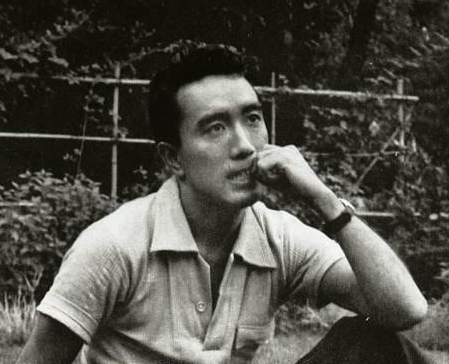
Mishima Yukio is the pen name of one of the most significant figures in the postwar 20th century Japanese literature. His aesthetic combination of traditional and modern has a long lasting influence, and this as well as other aspects of his life has been greatly publicized through various means of scholarly effort and public media. I merely would like to view him through the looking glass provided by two of his works, and fill in some necessary details to make a more or less complete story out of it.

 
The book I read from him some time ago was his "Confessions of a Mask" (1949), one of his early works, and the one that actually made him famous. In short, this is a semi-autobiographic novel, and tells the life experiences of a young man called Kochan raised in the militaristic contemporary Japanese society. Kochan is a physically weak, sensitive child, who is raised largely in isolation, and becomes involved in a fantasy world. A central element of his fantasies is his fascination with death. On the one hand, he finds romance in the idea of death as an escape into heroism from the realities of life. On the other hand, he increasingly fancies idealized male figures, whose full attraction is apparent to him only in the moment of their heroic and often grotesque death. The latter fantasies become the basis for his latent homosexuality. Later he admires a classmate for his masculine strength and body, something that he did not have but had always felt attracted to. At the same time, he develops a personality, the titular mask, behind which he hides these desires. Eventually, he even gets involved with a girl, going as far as kissing her, but while speaking about a sort of sympathy to her, he still remains amidst his fantasies. The most telling is perhaps the last meeting of the two near the end of the novel, interrupted by a description of a bloody fantasy involving a young man whom Kochan spotted. The fact that this novel made Mishima well-known is also worth pondering. I guess the degree of reality with which he wrote it, lends in itself artistic value to the novel, even though the topic it deals with is far from pleasant. Bloody fantasies at a very young age, and latent homosexuality, these are topics most readers of the book would perhaps not admit to have experienced, but which may have nevertheless formed part of the formative period of one's life, a part which he may later choose to forget. Mishima's realism is sensitive, not merely the automatic, unveiled and all revealing naturalism of a misguided surgeon cutting out a tumor only to kill the patient with it. That he was able to write a confession that was still interesting to wider audiences is alone a testimony for his talent.


The other work of Mishima that I intend to write about takes us near the end of his career. "Patriotism" of "The Rite of Love and Death" (1966), is a short film directed by Mishima, in which he also plays the main role of a Lieutenant of the royal guard and member of a group planning to overthrow the government they see unworthy for the service of the emperor. He is not participating in the actual coup d'état, mainly on account of his friends' appreciation of the devotion between him and his young wife. However, when the attempt fails, he is ordered to execute his friends. To deny this possibility, and at the same time remain loyal to the emperor, he decides to commit ritual suicide as the only honorable solution. He is rejoiced by the devoted decision of his wife to follow him in this act of honor, preceded by an intensified sexual experience brought about by the closeness of death. One might wonder, knowing what similar events took place later in Mishima's life, what happened to the character of Kochan, who falsely admitted having tuberculosis to avoid military service in the war, leading to almost certain death. In the mean time, Mishima has gone through a number of changes. He took up weight lifting, and overcame his initial weakness, becoming a male model. He also adopted a sort of nationalism, which clashed in a number of points with the mainstream patriotism (e.g. on the bushido). He also got married in 1958. Seeing from the point of view of only these two of his works, it appears that his fascination with death (and perhaps also that with the ideal male) was satisfied in the romance of nationalism, a historically supported possibility for heroic and honorable death. This possibility was perhaps more important that any other aspect of his nationalism, a way of expression for "tendencies" Kochan had to deal with. Mishima's real life attempt for a coup d'état, seems also to have been authored within the same spirit, as if anticipating failure, and leading to a romantic end. He did indeed commit seppuku in 1970, though the romance could have been somewhat spoiled by the several failed attempts by his aid to behead him. In my opinion, Mishima was an immensely sensitive and talented artists, whose romantic urges were impossible to satisfy in his contemporary social environment, which lead to his fantasies turning into a tragic reality. This leaves me thinking whether we have nowadays reached a level of awareness in dealing with sensitivity and "tendencies", which would make such an outcome less likely...

Sunday, 15 July 2012

Pagliacci

Pagliacci (Clowns) is an opera composed by Leoncavallo. The basic storyline concerns a group of traveling actors (clowns), whose repertoire includes a comic scene between a cheated husband and his wife. This scene is played by the actor Canio, and his real life wife. However, by the end of the opera, Canio realizes that his wife indeed cheats on him. The final scene includes the performance of the supposedly comic scene turning into tragedy. Canio tries initially to play his role, but the lines are now filled with real emotions, which first their audience applauds. Confusion arises when gradually all pretenses of a play are dropped, and finally a real crime of passion is committed. It is under these circumstances that Canio sings the arietta of his role No! Pagliaccio non son! full with real emotions. Many a famous performance of this peace is known, it was for example considered a signature role of Caruso. The version I am now posting here is with Pavarotti. I have found this on youtube, and I was happy when I did, for I think I found treasure. Please, enjoy!


Sunday, 3 June 2012

My Favourite Villain From 'The Tick'

The Tick was the title of a comic and TV series. The parts I am now posting are from the 1994 animated series episode 'The Tick vs. The Uncommon Cold'. As viewers of the show may well know, this was a comic turn on the superhero concept, practically by inventing a big-muscle-small-brain superhero who has to face all enemies that the creators of the likes of Superman or Spider Man never dared to imagine. In this particular episode, Thrakkorzog, evil ruler of dimension 14B, who rents an apartment in the neighbourhood of the Tick, plans on world domination by creating an army of Tick clones. However, he only manages to obtain a tissue sample in the form of a used tissue...

Thrakkorzog is an especially crazy villain... He and his speaking tongue plan on a brain eating mayhem with the manners and language of a fine gentleman. Table manners also seem to belong to his strong points, which is normally unusual from a slime based organism. But the thing I like best is the brutal reality that even an interdimensional space crawler and would be conqueror of Earth will have to submit to an even more universal and ruthless force: the written and unwritten laws of apartment renting...


Saturday, 31 March 2012

Ligeia

I have just found a short video I pasted together years ago. It is worth posting since it is made up of many things I liked that time, and even today. It is from "The Tomb of Ligeia", part of the Roger Corman series of low budget Gothic horrors featuring Vincent Price. I have already posted earlier a stage like Poe adaptation featuring Price, one of the iconic actors of the genre. He would probably have preferred that over the Corman series, but nevertheless, there aren't that many Poe adaptations, and the latter series definitely has that particular "Price appeal" that made him such a popular performer. Then, of course there is Poe himself. His short stories are rarely more than a few narrated scenes, but it is the dense atmosphere he is able to create in them that makes him enchanting, and at the same time his stories so hard to adapt to the medium of film. I mean it is not impossible (e.g. the aforementioned stage film), but in terms of the plot requirements of a more "standard" movie, they needed expansion, even risking the integrity of the original atmosphere of a Poe story. From this respect, the Corman series performs better than most other popular Poe adaptations I can now think of. Finally, the music... Divano from Era. Perhaps the overall atmosphere of the song is not that of a story as Ligeia, but I also remember that when the idea occurred to me to make this clip, I had in mind only the first part of the song, which is somehow slower and darker. I still like the whole song tho, and many others from Era. After all, the idea behind editing is to get parts of different things we like for one reason or the other, and paste them together into a new whole to reflect something of our own inner view on the world...

Thursday, 23 February 2012

Haunted By The Past...

This is a patched up version of a chat conversation I had recently with a friend that I made into a standalone text. I like allegoric things, but I have not yet done too much which would put this tendency into some purely fictional context. So my best chance to show something of this is to take one such episode, improve it a bit, so that it would be more independent of the specific situation, and post it here as a sort of self expression... Well, here it goes:

"Midway upon the journey of our life…

Haunted by spirits of the past I find myself facing a house without a door, whose grandeur promises safe haven, and yet its strong walls forbid entry. There are other houses around, but still I want to find a way to get into this one. Yet this does not stop me form sneaking in whenever a neighbor forgets to close the window. By the fire it's easier to forget that yet another spirit from the past has tracked me down… I spend a little time there until someone notices that there is a draft and decides to close his window. Then I have to leave too… mostly back to the house with no doors… because for some reason I cannot get it through my head that I cannot get in, and expect that maybe out of a thousand I will be the one who will manage to dig a hole into a stone wall with my bare hands.

The past haunts me… call it dramatic, if you wish. It is as dramatic as waiting for Godot. A kind of human-paced drama, without gigantic heroes and the cathartic experience that goes along with it. That is unless you create yourself a world in which you can be the dramatic hero… but this world will be the one in which we are really left alone, because here "everybody" is just a marionette figure who does nothing but our will…

Yet I don't want you to give the feeling that there is no happiness in life. It would have been long over if not so. But the stone wall of that certain house still attracts me, maybe for the very reason that it is nearly impossible to get through, or at least not the way I have tried so far. Yet it calls me still, as at the bottom of my soul I think, I know, I feel that there still is a way… it even teases me by saying it's not that it's impossible to get in, it's just that I am unable to learn how... and it annoys me that in reality this translates to the fact that this is almost the third decade of my life when this stone wall still throws me back whenever I try pushing it… Don't laugh! I'd rather not push… I'll just stay there and watch hoping that I discover a crack on it, because there has to be one! But at the same time I am afraid, because after three decades, I feel I am somehow late. My joy comes from sneaking in to neighboring houses or strangely from the fact that while I am sitting by this wall I do sometimes think that for a moment I did see something shining through the wall from that light that I hope to find inside. These moments, the little things are those that still matter, and these are the things that keep me trust in being as much as making me want to continue…"

Sunday, 22 January 2012

A Funeral And A Poet


Films are often thought of as belonging to the dramatic genre, like theatre, with an emphasis on dialogue and the resulting confrontation of characters leading to a final catharsis. However, the medium of film is quite capable of expressing more poetic or narrative features as well. In this scene from Doctor Zhivago, the young poet attends his mother's funeral. What may take a few pages to describe in a novel, the way he feels, is done here by silent acting and visual poetry. Things that would be clumsy if they were told in a dialogue, and probably less effective via simple narration. A way to describe a sensitive person in film is to guide the camera to see what he perceives from what is going around him. The fall of the leaves and the blow of the wind, the slow but powerful accumulation of gentle feelings interrupted by the disturbing reality of the sight of someone whom one had seen living, walking, breathing... enclosed motionless in a box and buried underground. Meanderings of a perception quite easily attracted by the subtle ways reality is wrapped around us, among which death is only one; one, perhaps not fully understood at the first encounter, one that may not even seem more important than others, yet stubborn and unalterable. A poet's way to introduce a poet...

Sunday, 15 January 2012

Daft Punk - Interstella 5555


Daft Punk - Harder, Better, Faster, Stronger von Darksith47

Interstella 5555 is an animated film for the album Discovery of Thomas Bangalter and Guy-Manuel de Homem-Christo, better known as Daft Punk. It is a bitter-sweet story of some alien musicians who are abducted from their home planet to be brought to Earth and form a band here. The animation was supervised by Leiji Matsumoto, a veteran of animated space sagas. I have chosen two tracks to post here. "Harder, Better, Faster, Stronger", which I often hear when I work to give me the feeling that my work is great and important... :) The other is "Aerodynamics", which simply just communicates something exciting to me... like my electric nerve impulses were part of the music, and somebody was able to play something nice using them...


Daft Punk - Aerodynamic von EMI_Music