Saturday, 28 July 2012

Walking My Baby Back Home


"Walking My Baby Back Home" is the title of a popular song that gave its name to a musical made in 1953. Above is the title sequence of the movie, and the first musical piece, the equally popular "Glow Little Glow Worm". The story is about a musical band looking for an identity, and finally finding it by rediscovering to Dixieland Jazz. Probably not the most famous one of musicals, and not with an overly complicated plot, but what is important, with a number of good musical tracks. In the main roles are Donald O'Connor, probably most well known for his role in "Singin' in the Rain", and Janet Leigh, most remembered after her meeting a terrible end under the shower in Hitchcock's "Psycho". On a personal note, I think O'Connor should have been given more opportunity to show his talent... and it is on this note that I have mainly selected scenes in which he performs, although Janet Leigh is also charming at places, and it was through her that I learned about this musical in the first place. I guess I am not the only one, who after seeing her in the Columbo episode "Forgotten Lady", wanted to learn more about the musical so emblematic for her character, who kills her husband to revive her career.


If some of the choreography in the first video reminds me a bit of Michael Jackson, than the second video of Donald O'Connor's step performance somehow suggests Michale Flatley, not as if there was any more direct link between these performers that I know of. In any case, this step sequence should join some scenes from "Singin' in the Rain", in my personal list of favorite moments with him. Last but not least, a comical scene, where O'Connor's character has to suffer an opera lesson given by a "more" than enthusiastic matron of the genre... For those who want more, the whole musical can be found here.


A Note on Dramatic Experience

In 2008, I wrote a short note with the following title, which I rediscovered recently. I have read it through, and changed a few smaller things in it, and so I thought, it could be published here, as a relic from a part of my personal intellectual history. What I wrote was not meant to be a strict categorization, rather an attempt to identify certain poles in dramatic experience, between which many continuous stages are possible. Well, here it goes:

In the arts and literature, drama is the genre that is basically meant for performance. The word itself comes from the ancient greek for ”to do”, meaning ”action”. During history, in different times and places, many varieties have evolved, from classic Greek dramas to the absurd theatre of the 20th century. This variety is described in many ways by many scholars. In the followings, only briefly some notes will be made based on the effect drama has on its audience. The focus is on how the dramatic act moves the viewer, which will draw a fuzzy border across the field, splitting it up to two regions.

One may talk about monumental dramas, like Hamlet, or other Shakespearean dramas, or dramas of the ancient classics. They are usually built around grand scale emotions, that the dramatic situation creates in characters, and by viewing, in the audience. This will lead to catharsis, ”purification”, in the sense that the viewers’ emotions are moved by the drama, and thus become expressed, and the viewer therefore purified. Therefore, catharsis here comes from identification. Identification of oneself with one of the characters, or rather, with his feelings which are given a monumental setting. It follows that for this to be effective, there should be only one dominant point of view. Like although we know a lot about Claudius, we see the events through Hamlet’s point of view. Monumentality requires that only the part of reality should be considered, or rather be justified, which promote the break-through of the emotion the act is built upon, simply because that is the nature of emotions, they don’t respond logically, they don’t consider. Therefore the heroes and villains are typically personalities of a certain emotion, or other dominant characteristic.

The other branch would be observational dramas, like Brecht’s work. In Brecht’s work, the identification was deliberately disturbed by various alienating effects. This means that there is no catharsis here in the above sense, and the audience is invited to observe, rather than to identify with the characters. Monumentality is put into a kind of vacuum. However, one may experience a different kind of catharsis here, one which is based on recognition. Instead of becoming monumental, this approach moves to the other direction of emotional ”sizes”. In the absurd, it is frequent that the same emotional psychology operates as in monumental dramas, but with minute events - instead of the death of one’s father, the unability to tie a shoelace may become the centre of emotions. We learn something different of our emotions here compared to the monumental where they are maximized and cast out; through a different emphasis, we see where they originate from, and often how they are expressed in our lives. This expression is rarely of grand scale (hence harder to identify with), rather, it is in everyday terms and events, and putting all intensity of accumulated emotions into such means is where the absurd is rooted. Absurd is one way to shift to observation, and the recognition of the emotional process is what brings catharsis, as if for a moment one would see himself from outside. More views can be present here equally dominantly, which often makes the contradiction less sharp, and the consequences suddenly serious.

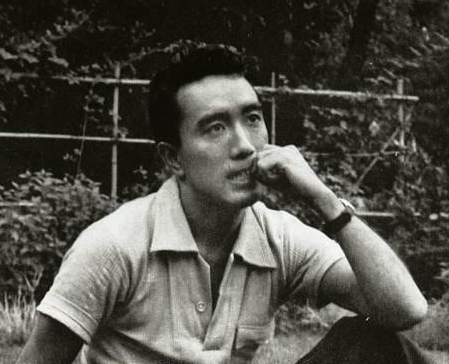
Mishima

Mishima Yukio is the pen name of one of the most significant figures in the postwar 20th century Japanese literature. His aesthetic combination of traditional and modern has a long lasting influence, and this as well as other aspects of his life has been greatly publicized through various means of scholarly effort and public media. I merely would like to view him through the looking glass provided by two of his works, and fill in some necessary details to make a more or less complete story out of it.

 
The book I read from him some time ago was his "Confessions of a Mask" (1949), one of his early works, and the one that actually made him famous. In short, this is a semi-autobiographic novel, and tells the life experiences of a young man called Kochan raised in the militaristic contemporary Japanese society. Kochan is a physically weak, sensitive child, who is raised largely in isolation, and becomes involved in a fantasy world. A central element of his fantasies is his fascination with death. On the one hand, he finds romance in the idea of death as an escape into heroism from the realities of life. On the other hand, he increasingly fancies idealized male figures, whose full attraction is apparent to him only in the moment of their heroic and often grotesque death. The latter fantasies become the basis for his latent homosexuality. Later he admires a classmate for his masculine strength and body, something that he did not have but had always felt attracted to. At the same time, he develops a personality, the titular mask, behind which he hides these desires. Eventually, he even gets involved with a girl, going as far as kissing her, but while speaking about a sort of sympathy to her, he still remains amidst his fantasies. The most telling is perhaps the last meeting of the two near the end of the novel, interrupted by a description of a bloody fantasy involving a young man whom Kochan spotted. The fact that this novel made Mishima well-known is also worth pondering. I guess the degree of reality with which he wrote it, lends in itself artistic value to the novel, even though the topic it deals with is far from pleasant. Bloody fantasies at a very young age, and latent homosexuality, these are topics most readers of the book would perhaps not admit to have experienced, but which may have nevertheless formed part of the formative period of one's life, a part which he may later choose to forget. Mishima's realism is sensitive, not merely the automatic, unveiled and all revealing naturalism of a misguided surgeon cutting out a tumor only to kill the patient with it. That he was able to write a confession that was still interesting to wider audiences is alone a testimony for his talent.


The other work of Mishima that I intend to write about takes us near the end of his career. "Patriotism" of "The Rite of Love and Death" (1966), is a short film directed by Mishima, in which he also plays the main role of a Lieutenant of the royal guard and member of a group planning to overthrow the government they see unworthy for the service of the emperor. He is not participating in the actual coup d'état, mainly on account of his friends' appreciation of the devotion between him and his young wife. However, when the attempt fails, he is ordered to execute his friends. To deny this possibility, and at the same time remain loyal to the emperor, he decides to commit ritual suicide as the only honorable solution. He is rejoiced by the devoted decision of his wife to follow him in this act of honor, preceded by an intensified sexual experience brought about by the closeness of death. One might wonder, knowing what similar events took place later in Mishima's life, what happened to the character of Kochan, who falsely admitted having tuberculosis to avoid military service in the war, leading to almost certain death. In the mean time, Mishima has gone through a number of changes. He took up weight lifting, and overcame his initial weakness, becoming a male model. He also adopted a sort of nationalism, which clashed in a number of points with the mainstream patriotism (e.g. on the bushido). He also got married in 1958. Seeing from the point of view of only these two of his works, it appears that his fascination with death (and perhaps also that with the ideal male) was satisfied in the romance of nationalism, a historically supported possibility for heroic and honorable death. This possibility was perhaps more important that any other aspect of his nationalism, a way of expression for "tendencies" Kochan had to deal with. Mishima's real life attempt for a coup d'état, seems also to have been authored within the same spirit, as if anticipating failure, and leading to a romantic end. He did indeed commit seppuku in 1970, though the romance could have been somewhat spoiled by the several failed attempts by his aid to behead him. In my opinion, Mishima was an immensely sensitive and talented artists, whose romantic urges were impossible to satisfy in his contemporary social environment, which lead to his fantasies turning into a tragic reality. This leaves me thinking whether we have nowadays reached a level of awareness in dealing with sensitivity and "tendencies", which would make such an outcome less likely...

Sunday, 15 July 2012

Pagliacci

Pagliacci (Clowns) is an opera composed by Leoncavallo. The basic storyline concerns a group of traveling actors (clowns), whose repertoire includes a comic scene between a cheated husband and his wife. This scene is played by the actor Canio, and his real life wife. However, by the end of the opera, Canio realizes that his wife indeed cheats on him. The final scene includes the performance of the supposedly comic scene turning into tragedy. Canio tries initially to play his role, but the lines are now filled with real emotions, which first their audience applauds. Confusion arises when gradually all pretenses of a play are dropped, and finally a real crime of passion is committed. It is under these circumstances that Canio sings the arietta of his role No! Pagliaccio non son! full with real emotions. Many a famous performance of this peace is known, it was for example considered a signature role of Caruso. The version I am now posting here is with Pavarotti. I have found this on youtube, and I was happy when I did, for I think I found treasure. Please, enjoy!


Sunday, 3 June 2012

My Favourite Villain From 'The Tick'

The Tick was the title of a comic and TV series. The parts I am now posting are from the 1994 animated series episode 'The Tick vs. The Uncommon Cold'. As viewers of the show may well know, this was a comic turn on the superhero concept, practically by inventing a big-muscle-small-brain superhero who has to face all enemies that the creators of the likes of Superman or Spider Man never dared to imagine. In this particular episode, Thrakkorzog, evil ruler of dimension 14B, who rents an apartment in the neighbourhood of the Tick, plans on world domination by creating an army of Tick clones. However, he only manages to obtain a tissue sample in the form of a used tissue...

Thrakkorzog is an especially crazy villain... He and his speaking tongue plan on a brain eating mayhem with the manners and language of a fine gentleman. Table manners also seem to belong to his strong points, which is normally unusual from a slime based organism. But the thing I like best is the brutal reality that even an interdimensional space crawler and would be conqueror of Earth will have to submit to an even more universal and ruthless force: the written and unwritten laws of apartment renting...


Saturday, 31 March 2012

Ligeia

I have just found a short video I pasted together years ago. It is worth posting since it is made up of many things I liked that time, and even today. It is from "The Tomb of Ligeia", part of the Roger Corman series of low budget Gothic horrors featuring Vincent Price. I have already posted earlier a stage like Poe adaptation featuring Price, one of the iconic actors of the genre. He would probably have preferred that over the Corman series, but nevertheless, there aren't that many Poe adaptations, and the latter series definitely has that particular "Price appeal" that made him such a popular performer. Then, of course there is Poe himself. His short stories are rarely more than a few narrated scenes, but it is the dense atmosphere he is able to create in them that makes him enchanting, and at the same time his stories so hard to adapt to the medium of film. I mean it is not impossible (e.g. the aforementioned stage film), but in terms of the plot requirements of a more "standard" movie, they needed expansion, even risking the integrity of the original atmosphere of a Poe story. From this respect, the Corman series performs better than most other popular Poe adaptations I can now think of. Finally, the music... Divano from Era. Perhaps the overall atmosphere of the song is not that of a story as Ligeia, but I also remember that when the idea occurred to me to make this clip, I had in mind only the first part of the song, which is somehow slower and darker. I still like the whole song tho, and many others from Era. After all, the idea behind editing is to get parts of different things we like for one reason or the other, and paste them together into a new whole to reflect something of our own inner view on the world...

Thursday, 23 February 2012

Haunted By The Past...

This is a patched up version of a chat conversation I had recently with a friend that I made into a standalone text. I like allegoric things, but I have not yet done too much which would put this tendency into some purely fictional context. So my best chance to show something of this is to take one such episode, improve it a bit, so that it would be more independent of the specific situation, and post it here as a sort of self expression... Well, here it goes:

"Midway upon the journey of our life…

Haunted by spirits of the past I find myself facing a house without a door, whose grandeur promises safe haven, and yet its strong walls forbid entry. There are other houses around, but still I want to find a way to get into this one. Yet this does not stop me form sneaking in whenever a neighbor forgets to close the window. By the fire it's easier to forget that yet another spirit from the past has tracked me down… I spend a little time there until someone notices that there is a draft and decides to close his window. Then I have to leave too… mostly back to the house with no doors… because for some reason I cannot get it through my head that I cannot get in, and expect that maybe out of a thousand I will be the one who will manage to dig a hole into a stone wall with my bare hands.

The past haunts me… call it dramatic, if you wish. It is as dramatic as waiting for Godot. A kind of human-paced drama, without gigantic heroes and the cathartic experience that goes along with it. That is unless you create yourself a world in which you can be the dramatic hero… but this world will be the one in which we are really left alone, because here "everybody" is just a marionette figure who does nothing but our will…

Yet I don't want you to give the feeling that there is no happiness in life. It would have been long over if not so. But the stone wall of that certain house still attracts me, maybe for the very reason that it is nearly impossible to get through, or at least not the way I have tried so far. Yet it calls me still, as at the bottom of my soul I think, I know, I feel that there still is a way… it even teases me by saying it's not that it's impossible to get in, it's just that I am unable to learn how... and it annoys me that in reality this translates to the fact that this is almost the third decade of my life when this stone wall still throws me back whenever I try pushing it… Don't laugh! I'd rather not push… I'll just stay there and watch hoping that I discover a crack on it, because there has to be one! But at the same time I am afraid, because after three decades, I feel I am somehow late. My joy comes from sneaking in to neighboring houses or strangely from the fact that while I am sitting by this wall I do sometimes think that for a moment I did see something shining through the wall from that light that I hope to find inside. These moments, the little things are those that still matter, and these are the things that keep me trust in being as much as making me want to continue…"