It's been a while since I saw an egg shoeing process, and recently I just remembered in connection with something requiring a lot of patience. Indeed, it was originally to demonstrate (and show off with) one's craftsmanship. There are still a few people who do egg shoeing ('tojáspatkolás') in Hungary. Next time I am impatient about something, I will remember to try and drive a nail into an egg instead...
Some years ago I did a translation of the song of Ágnes Vanilla below. It is part of an album, where each song is a musical adaptation of a József Attila poem. This particular one happens to be my favorite of the lot and it appears to be popular also among non-Hungarian people, and still one may find many requests for a translation on youtube. Mine got lost during the past few years, and there were many other attempts ever since. It is however, a very difficult task, since the lyrics is actually a poem of one of the greatest Hungarian poets, József Attila (Attila József in the English name order). The text is full of subtleties that are difficult to translate in the same compact verse form that the original used. I attempted that once. What I would like to do here is a bit different. I would like to give a transcription rather than a translation, in the sense that I would provide a more lengthy description for the lines than what would be possible if I attempted to put it into verse. The best suited person for such a task would be bilingual anyway, since only a person who knows subtleties in both languages can decide how to adapt or occasionally replace a phrase in the original with one that carries similar meaning in the target language.
József Attila had the difficult life of an artist, who found it hard to conform to some of the norms of his contemporaries. He attempted suicide several times, was fired from university, and got into conflict with the authorities because some of his poems were considered politically or otherwise incorrect. While previous generations learned that he was schizophrenic, updated textbooks urge the knowledge on younger generations that in fact he had borderline personality disorder. Whether his early death at the age of 32 in 1937 was an accident or suicide, is still not unanimously agreed upon. The fact remains he found his death among some railway tracks. His fame increased after his death, he is introduced to students among artists influenced by the Avant-garde (e.g. surrealism), others discuss his relation to transrealism.
The poem Óh szív! nyugodj! (Oh Heart! Be Still! written in 1928) repeated twice, is the lyrics of the above song. I will try to restrict myself to a technical/raw translation. The poem is a depiction of a winter scenery (daybreak), where various natural phenomena trigger poetic emotions. At least this is how I would summarize it, without too much explanation. Of course, here, and in the following, I base my translation on the image the poem triggers in my own mind. There are 4 stanzas:
Fegyverben réved fönn a téli ég,
Above, the winter sky daydreams in arms,
kemény a menny és vándor a vidék,
heaven is hard and the land is a wanderer,
halkul a hó, megáll az elmenő,
snowing decreases, someone leaving stops,
lehellete a lobbant keszkenő.
his breath is the flickered handkerchief.
The verb 'réved' is related to the French 'rêve' (dream), and perhaps could be translated as 'be in a reverie'. I personally imagine here that certain sleepy awareness that just precedes full awakening, and so it could perhaps also be translated as 'awakes armed in a reverie', though that sounds a bit complicated to me. The land is a wanderer could perhaps also be rendered as 'the land wanders'. In 'halkul a hó' halkul lit. means to become less loud, all in all it would be "the snow becomes less loud". In the last line flicker stands for 'lobban', which refers to one flicker rather than many rapidly suceeding ones (the latter would be 'lobog').
Hol is vagyok? Egy szalmaszál nagyon
Where am I? A straw moves about
helyezkedik a csontozott uton;
intensely on the boned road;
kis, száraz nemzet; izgágán szuszog,
little dry creature; snuffs restlessly,
zuzódik, zizzen, izzad és buzog.
(it) gets bruised, buzzes, sweats and boils.
The first two lines constitute one sentence (other than the initial question). 'Helyezkedik' means something like tries to find its place. For 'csontozott', 'boned' is risky. The first meaning of the corresponding verb would be to remove the bones, and so the participle here would mean boned or boneless. Together with the winter context I imagine bony patches of snow on the road when I say 'boned road'. The word 'nemzet' means nation, and I have seen it translated like that many times. However, I think 'nemzet' here stands in its more direct derivative meaning (something similar to 'fajzat'), i.e. 'creature'. The last line has a phonetic message, all verbs there contain 'zz' reminding one to noises a piece of straw could make.
De fönn a hegyen ágyat bont a köd,
But up on the mountain, the mist is making the bed,
mint egykor melléd: mellé leülök.
like once beside you: I sit beside it.
Bajos szél jaját csendben hallgatom,
I listen in silence to the laments of the troubled wind
csak hulló hajam repes vállamon.
only my falling hair flies about on my shoulder.
'The laments of the troubled wind' would lit. be the 'ouches of...' where 'jaj' is 'ouch'.
Óh szív! nyugodj! Vad boróka hegyén
Oh Heart! Be Still! On the mountain of the wild juniper
szerelem szólal, incseleg felém,
love talks, flirts to me,
pirkadó madár, karcsu, koronás,
a dawning bird, slender, with a crown,
de áttetsző, mint minden látomás.
but transparent as all visions.
And here, one has actually little trouble to give a literal translation. The question remains whether all this helps to understand the original? To convey the poetry, definitely, a poetic translation is needed, more suited to the subtleties of the English language. But in such a procedure, the taste of the original is likely to suffer, and I hope that with this more literal translation, I have managed to transfer at least some of it.
"Les Diaboliques" is the title of the film adaptation of the Boileau-Narcejac novel "Celle qui n'était plus" (She, who was no more). Written in 1952, the novel appeared in English in 1954, and in 1955 it was made into a film by H. G. Clouzot, who obtained film rights to the novel a little before Hitchcock could have. All the more interesting, that today the name Boileau-Narcejac seems to have lost its familiar ring to the fans of the thriller genre, unlike their American counterparts (e.g. Chandler). English translations of the novel are hard to come by and some sellers ask astronomical prices for them. The pseudonym refers to two authors, Pierre Boileau and Thomas Narcejac, who much in the style of Ellery Queen, divided the task of plotting and writing among themselves. The aforementioned novel is their first success to be followed by many other.
The first thing that comes to mind about the rather short novel is the strong atmosphere. The reader follows a murder plot, and as the characters move along in the dark and misty world surrounding them, one has the feeling that we are turning away from reality into a world of inner fears to complete a psychological journey with a dramatic conclusion at the end. It is like a landscape at night, with an interplay of dark shades that has some unearthly beauty for the outside observer, but crushes the main character with its deadly magnetism. The novel consists of such scenes, for instance a nocturnal journey with a dead body in the back of the car, where every little obstacle tries the mental stability of the plotters. Much emphasis was laid on the ending in the trailer for the movie. It should be mentioned that whereas the background had been changed for the movie, the structure of the plot, and the main twist survived. However, the film is much less pessimistic, the atmosphere is somewhat lighter. Nevertheless, it was made in the spirit of the novel, about the same aspects of human nature. Interestingly, there is an exchange of roles as the main character in the novel corresponds more to his wife in the movie, and vice versa. It seems the makers of the film did not envision a psychologically tormented, weaker male character, but a rather menacing and tyrannical one. Thus, in a way, film and novel are complementary, both recommended heartily.
At one point, while writing parts of a history of detective stories, looking for possible oriental relatives, I stumbled upon the name of Judge Di (Dee). Di Renjie (630-700) is a historical figure, a capable minister of the Tang dynasty. Loosely based on Di and his reputation, an unknown 18th century author wrote "Di Gong An", a detective novel in which Di as a magistrate investigates a number of crimes. A copy of this was obtained by the dutch sinologist Robert Van Gulik in a Tokyo second-hand bookstore, and was later translated by him into English as "Celebrated Cases of Judge Dee". More precisely, he translated the first part of the novel, and argued that the second part is a later addition much inferior in style and plot. Van Gulik wrote a detailed introduction to his translation, in which he observed some differences between the oriental and western styles of detective stories. He intended to introduce to the Western audience an authentically Chinese detective, unlike the stereotypical Western inventions popular at his time. Then, he went on encouraging authors to write similar stories based on these rules. Eventually, he did so himself, and invented a completely imaginary career for Judge Di spanning over several locations and levels of Chinese jurisdiction. One of the most notable characteristics of the Judge Di novels is the parallel investigation of several cases in the same time, which are investigated by the magistrate with the help of his trusted lieutenants. Although the whodunit is not typical in Chinese crime fiction, Van Gulik often centered the mystery around the identity of the murderer in his novels, which he illustrated himself. After his death, many authors continued his work, most extensively F. Lenormand in French.
There have also been film adaptations of the character. A close adaptation of the Van Gulik novel "Judge Dee and the Haunted Monastery" was made in 1974. The Chinese television also started a series about the historical character, Di Renjie, and in 2010, Tsui Hark did "Judge Dee and the Mystery of the Phantom Flame" featuring Andy Lau in the titular role. Both Chinese adaptations take place in the period of the reign of Wu Zetian. Wu is certainly one of the most intriguing figures of Chinese history, and the only woman to have obtained the title of huangdi as founder of the short lived Zhou dynasty (690-705). It is certainly an attractive proposition to bring together two such historical figures in one plot, though Di should have been around 60 when the events of the Phantom Flame were supposed to take place. Both Chinese film adaptations are wire fu, and there is a new Tsui Hark film coming out as a prequel. On the other hand, Haunted mystery is a sort of cheap but faithful adaptation. Faithful, I mean, to the book by Van Gulik. By the time he wrote Haunted Monastery, Van Gulik seems to put less emphasis on the court procedure and other details, e. g., the morbid details of execution in the end, and the setting of an old monastery with a spooky air where he takes shelter when his journey is interrupted by a storm gives just the right background to dispose of these formalities. Van Gulik still keeps that original feature of his novels to set his plot in the Tang dynasty but describe customs of the Ming, as did the anonymous writer of the original Di Gong An. However, the average viewer of the film version would notice few of this, and I don't think it makes a big difference given the rather improvised settings, nowhere near the sometimes purely imaginary magnificence of the past as in Phantom Flame. The environment also provides Van Gulik with the possibility to discuss the differences of thought advocated by Confucians and Taoists, but again, the film carries over little of this. However, the plot is almost unchanged, which is a huge advantage, as Van Gulik used elements of recorded case histories in his novels, and thereby one has the chance to get some insight into the Chinese way of thinking about, committing and investigating crime. While writing to a western audience, Van Gulik repressed the role of the supernatural, which occasionally occurs in Di Gong An. Phantom Flame restores this element to some extent, in the manner of a Chinese phantasy, though once one accepts these elements as belonging to a mythical past, the flow of events - even if somewhat on the fantastic side - can still be reconstructed by logical deduction, which is why this may be called a detective story after all. At this point, I would compare the Phantom Flame to the French movie 'Vidocq', which builds similarly on the myth (or reality) of alchemy.
Reason is important and should play a large role in our lives. After all, we enjoy achievements of technical and other kinds that are largely thanks to reason. Many of the forms of magic is also reasonable, if not entirely scientific. However, the aspect of magic closest to me is its relation to the irrational and the imaginary. The latter two are important, even if we assume that everything can be explained on a purely rational basis. In fact, one of the major underlying theme of current social problems , I think, is the inability to deal with the irrational. On the one hand this means that there is an irrational aspect of the human existence (and again, it may as well be described by rational means), an important one, which does not want to follow rules and laws. Instincts, hidden desires and the sort, some of which are simply banned, ignored, maybe punished, until they possibly return in a monstrous form (to borrow an expression used to describe Gothic horror). On the other hand, there is a not entirely unrelated, but rather more purely aesthetic or atmospheric aspect, that I merely refer to as poetry. This latter aspect is the one that I wanted to deal with here, solely in the framework of fiction.
It is the appeal of magic, which is magical. Whether it is an an atmosphere of ancient wisdom and sorcery or enchantment by the beauty of something, it is the appeal that I like and not whether it works in the physical world or not. In this sense it can be a very useful, in a way surreal craft to approach real and unreal in fiction. There are plenty of examples. Lovecraft's myth and its deadly book the Necronomicon, that so effectively embodies the occult and fearful, since we never can read it but know that whoever did, went crazy or worse. There is Polanski's "Ninth Gate" which takes us to the realm of old books, very rare and containing hidden knowledge only to the initiated. There is Burton's "Sleepy Hallow", an adventure in the world of Gothic and magic.
However, I wanted to show a few clips from Miyazaki's "Howl's Moving Castle" as ones I especially like. It is the story of a magician, Howl, who gave his heart to a demon, and a young girl, Sophie, who is turned into an old woman by a witch. The country is in war, which Howl finds mad, and sometimes interferes with. He is also hiding from his teacher, the royal sorceress, Saliman, who wants to put a control on magical practices in the country. The first scene shows the discovery of a malicious magic spell. I merely post it because it has the appeal I was referring to. The second is the confrontation scene with Saliman, where Sophie, now as an old woman, poses as Howl's mother. I love the idea of danger hidden behind such innocent looking things as that chanting... Like in other works of Miyazaki, there are lots of surreal images, events and characters, which somehow look familiar but yet which would be hard to explain. In a way they are also about reality as experienced by the viewer, and yet things just "melt together" as if in a dream. Howl is especially a good example of this sort of magic...
I remember a psychiatrist once telling me he didn't believe in god, but always he always prayed before driving. His explanation was that it helps him relax, remove anxieties of what might happen and so on. Indeed, much of the history of "common magic" is about attempting to remove such real or imaginary threats from one's life. Rituals, ceremonies, prayers could be a useful tool to achieve this end. Indeed, often the ritual is more important that the actual credence in the reality of the thus addressed deity. Still with any tool, I guess the secret is how to use it, and what it should not become is an automatic procedure of habit or tradition.
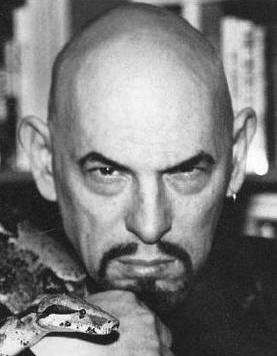
Magic always had a ritual aspect. Contemporary magical trends owe a lot to the work of Eliphas Levi, who developed a system of rituals and their theory, based in a large part on Renaissance traditions. The person who pushed ritualistic magic to its limits in the early 20th century was Aleister Crowley (see above). Being "the most evil man in the world", his hedonistic rituals including sexual practices and the use of drugs made him a scandalous figure of his time. He placed the notion of thelema, or true will (true in the sense that it also incorporates one's higher destiny) in the center of his practices, and experimented with I would say whatever the human body and mind could take, eventually ruining his health. As some of his practices would lead to less attention nowadays, I would also venture saying that some of the sort of hedonistic experiments he pursued are now incorporated into what is regarded as normal or acceptable, and such experiments may have played a crucial role in this change. Another development in this regard was the Satanistic movement of Anton LaVey (see below). LaVeyan Satanism is symbolic, i.e., it does not include worship of a Satanic deity, but rather uses Satan as a symbol of man's true nature. For example, the Satanistic parallel to the Christian Golden Rule would be "Do unto others as they do unto you", simply because it is considered false to expect the same consideration from others as one pays to them, since it is not in human nature. Here I would halt for a moment. While I sympathize with this dictum since it very often proves true in my personal experience, I think the same potential source of mistake is there as with the Christian parallel, namely mindless application justified by a doctrine. In other words, I think it is really the individuum that matters, and could make an intelligent decision whether in a given situation one or the other action would be appropriate. It involves risk as any action of free will. In any case, the modern satanist seems to pay much attention to individualism and materialism. Magic is now a psychological means to govern situations or focus one's emotions to a given purpose via rituals. On a final note regarding rituals of any kind, I think their danger lies in biasing ones own view on the world one way or the other, and so they may become the master rather than the servant.
While I do not fancy any form of religion or thought connected to churches or other organizations, since after all this is a private matter, one has to appreciate the role these organizations play in the course of history, and evaluate the appearance of newer ones as indicators of important questions of the time. Neopagan movements including modern Witchcraft, or Wicca, should also be mentioned among the practitioners of modern ritual magic. Their ritual practices appear much more light-hearted and playful than those mentioned above, they are perhaps advocates of an imagination less bound by reason.
In the history of magic, the Renaissance age plays an especially important role. While learned forms of magic were also to be found in the Middle Ages, it was because of the Renessaince rediscovery of ancient texts and cultural heritage that magicians felt they possessed a much fuller understanding of ancient traditions than their medieval predecessors. Magic became one aspect of a philosophical rediscovery of Platonic ideas as opposed to the Aristotelian scholasticism of the Middle Ages. Greek texts from the Byzantine empire, and arabic magical texts written under hellenistic influence became the primary sources for the Renaissance Mage.
Above all, the main influence was Marsilio Ficino's translation of the Corpus Hermeticum, writings attributed to Hermes Trismegistos, the supposed Egyptian equivalent of Moses. Although later scholarship discovered that this and other writings attributed to Hermes can be dated to the second or third centuries only, indicating a strong Neoplatonist influence, Renessaince scholars believed these texts to be much more ancient, and in fact to be the original influence on Platon. The authority thus attributed to them made Hermeticism and attached magical practices appear in a much more favourable light than did Medieval necromancers, and other learned practitioners of magic. Ficino then developed a sort of "natural magic", which aimed at exploiting the physically available forces in the Neoplatonist universe, namely those from planetary influences, which could be used to one's benefit through the arrangement of one's environment in a way sympathetic to a planetary force and the corresponding mental and other advantages. Furthermore, talismans could be prepared which would enhance the accumulation of such influences. Although the latter aspect was much frowned upon, Ficino avoided any attempts to manipulate spheres above the planetary one, inhabited by angels and other spirits, and he thus managed to avoid most accusations of heresy and the like. Later, this was to change when Pico della Mirandola introduced the Jewish Cabalistic tradition into Renessaince magic to attract angelic influences, and by the influential work of Cornelius Agrippa, who did not even exclude demonistic influence (see planetry symbols from his work below). The most notorious case was that of Giordano Bruno burned at the stake for his Hermetic beliefs now without Christian disguise. It was also on account of the importance Hermeticism placed on the sun that Bruno incorporated the Heliocentric view of Copernicus into his system.
At this point, magic and science are pretty close to each other, especially in the sense that both aimed at operations, producing effects in the world based on an application of knowledge, which was foreign from the contemporary scholastic thought. Hermetic influence decreased in the following centuries, especially since its sources were dated in the mean time, and as an operative explanation of the universe, the mechanistic universe was brought forward. Still, even Newton's mechanistic universe with gravity as an operational force reminded many of the invisible forces of the occult. Indeed, the better understanding of the nature of gravity came only through the work of Einstein, and continues arising questions until the present day.